Alternatives AUM is set to nearly double to $30 trillion by 2029, likely surpassing 20% of global AUM.¹ In the US alone, wealth management allocations to private markets have already doubled from 2% to 3-5% since 2020, representing $1.4 trillion in assets.² Meanwhile, 60% of investment managers surveyed by Alpha FMC are actively planning to launch alternative products in the next 12 months.³
The ambition is clear. But the infrastructure to support it - the data, the operating models, the client reporting - is struggling to keep pace. As Aiviq has observed first-hand, the technology and data ecosystem for tracking and reporting private markets lags behind equivalent public market infrastructure by at least a decade.
The Alternatives Data Problem
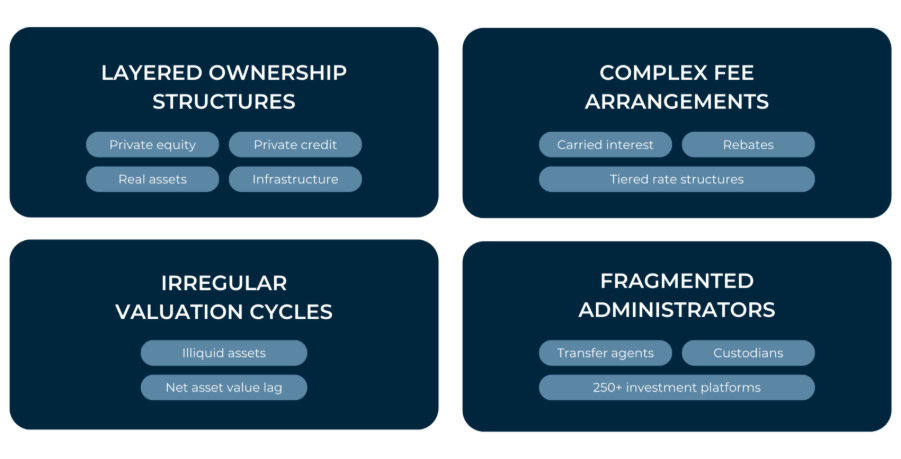
Unlike traditional long-only strategies, alternatives involve layered ownership structures, complex fee arrangements, irregular valuation cycles, and a fragmented web of third-party administrators, custodians, and execution venues. Each of these introduces data - inconsistent, siloed, and difficult to reconcile.
For global investment managers running multi-strategy alternatives platforms, this creates a compounding challenge. Institutional investors, sovereign wealth funds, and pension allocators - who already allocate 25% of AUM to alternatives in the case of UK pension schemes⁴ and up to 50% in the case of MENA family offices⁵ - expect seamless transparency across their entire exposure. Public and private, liquid and illiquid, in a single view. Delivering that without a unified client data foundation is not feasible.
Why Scale Makes It Worse
Managing alternatives at scale amplifies every underlying data problem. A single private markets mandate can touch multiple legal entities, sub-advisory arrangements, co-investment structures, and carried interest calculations. Multiply that across a global institutional client base and you face thousands of interdependencies that need to be governed, attributed, and reported accurately - often across jurisdictions with different regulatory requirements.
Firms relying on manual processes, spreadsheet-based reconciliation, or disconnected CRM and back-office systems face a hard ceiling. At Aiviq, we see investment managers attempting to analyse and report on hundreds of thousands of individual financial advisors working at over multiple different distributors and sub-distributors, transacting via different investment platforms, across a web of transfer agencies and custodians. Key-person dependencies, version-control failures, and fee calculation errors are not just operational annoyances - they create compliance exposure and, ultimately, client attrition.
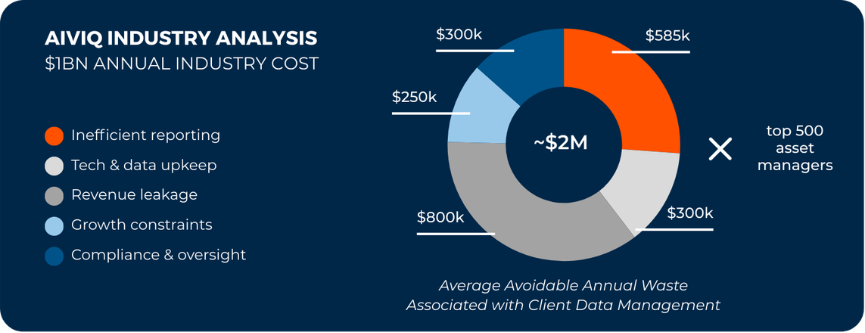
We estimated the average top-500 asset manager wastes close to $2 million annually on avoidable client data management costs. For alternatives-heavy managers, that figure skews materially higher.
What "Good" Looks Like
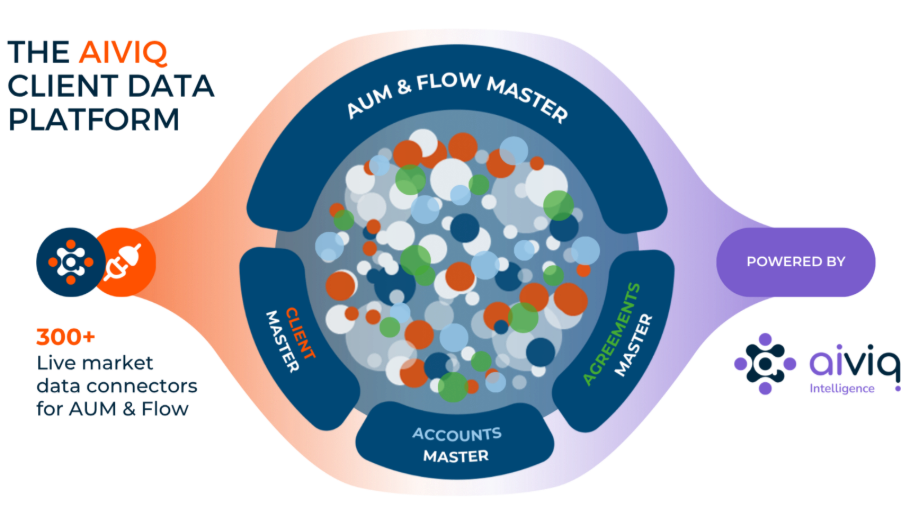
The firms navigating this well share a common denominator: a single, enterprise-grade client data platform that connects AUM and flow data, legal entity and agreements mastering, account attribution, and client relationship intelligence into one coherent architecture - front to back, across all jurisdictions.
As top managers diversify through multi-strategy asset classes, geographic footprint, and investor profiles, operating models are becoming more complex. That complexity is driving demand for a unified operating model built on consistent processes, intentional technology decisions, and a single data strategy. For alternatives managers specifically, the ability to connect data from sources like Alter Domus, Preqin, Apex and IQEQ alongside traditional distribution data is no longer a differentiator. It is the price of entry.
The convergence of public and private markets is reshaping everything. Read our full analysis of the forces driving alternatives growth - and what leading managers are doing about it.
.png)
The AI Opportunity - And The Data-readiness Gap
The investment management industry is moving rapidly beyond experimental AI to enterprise-wide implementation. But a critical "AI data-readiness gap" has emerged between AI's promise and its practical application. As Alpha FMC's AI & Analytics Lead has observed, firms with fragmented data ecosystems remain stuck in perpetual proof-of-concept purgatory - while those with consolidated, clean data architectures are deploying AI that delivers tangible business value.⁶
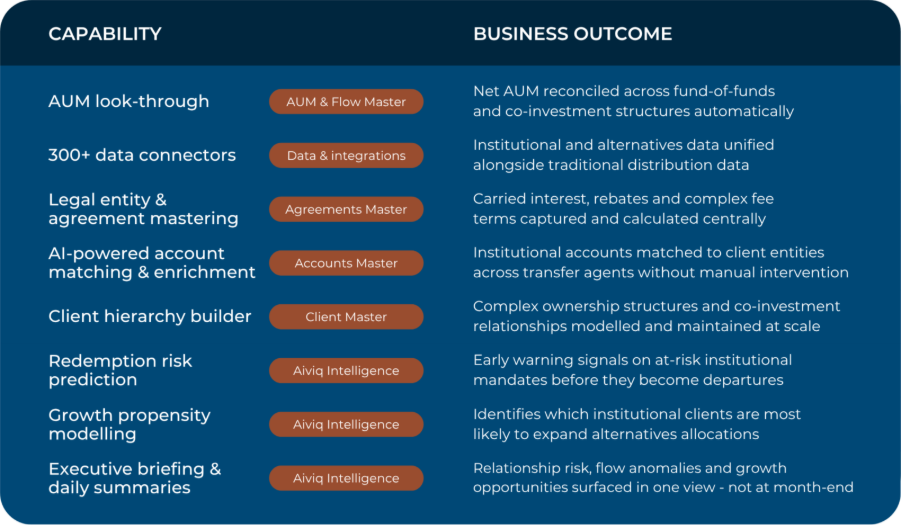
The right approach layers AI capabilities on top of a validated enterprise data model, not as a shortcut around one. The payoff for alternatives managers is significant: faster client onboarding, more accurate territory management, cross-border pattern recognition across historically disconnected regional silos, and vehicle-agnostic analytics across the full spectrum - from mutual funds and ETFs to private market investments and model portfolios.
The Window Is Narrowing
The convergence of public and private markets is accelerating. Regulatory frameworks like ELTIF 2.0 in Europe and interval fund structures in the US are opening alternatives to a broader investor base. The Great Wealth Transfer - $124 trillion expected to change hands across generations over the next 25 years⁷ - is bringing a new cohort of digitally-native investors into the conversation, with different expectations and higher demands.
Meanwhile, the top 20 global investment managers now control over 40% of total AUM, up from 36% in 2020.⁸ Scale advantages are compounding. Firms that have not yet built the data foundations to manage alternatives complexity are not just operationally disadvantaged - they are at existential risk of being unable to compete for the mandates that will define the next decade.
The winners will be those who can turn product complexity into strategic advantage through superior data consolidation and analytics. The ability to model potential outcomes across multiple dimensions - vehicles by region, channel and client segment - is fast becoming a critical competitive differentiator.
Aiviq's Client Data Platform is purpose-built for global investment managers running complex, multi-strategy books - including alternatives and private markets. With 300+ live market data connectors, a validated industry data model, and AI-powered intelligence embedded directly into your workflows, Aiviq gives you the enterprise-wide transparency to compete and grow.
Sources
- Preqin, Future of Alternatives 2029, September 2024
- Cerulli Associates, U.S. Alternative Investments 2024
- Alpha FMC, Asset Management Product Survey, 2024
- Preqin, UK pensions allocate almost a quarter of AUM to alternatives, November 2024
- UBS, Global Family Office Report 2025
- Alpha FMC, Asset & Wealth Management Outlook 2025
- Cerulli Associates, U.S. High-Net-Worth and Ultra-High-Net-Worth Markets 2024
- Thinking Ahead Institute, The World's Largest 500 Asset Managers, October 2024