Sales territory management is one of the most operationally critical - and most underinvested - disciplines in distribution. When it works, sales teams operate with clarity, CRM data stays clean, and revenue attribution flows naturally into the book of record. When it doesn't, firms spend a disproportionate amount of time on exception management, compensation disputes, and manual reconciliation that should never have been necessary in the first place.
If you're responsible for designing or maintaining a territory management framework - whether you're in sales operations, distribution, or finance - this guide covers the fundamentals: what good territory design looks like, how assignment and attribution should work in practice, and what to look for in a territory management tool.
What Is Sales Territory Management?
Sales territory management is the process of defining, assigning, and maintaining the coverage model that determines which territory member or team is responsible for which client relationships - and by extension, which trades, flows, and revenue are credited to them.
A territory can be defined by geography (country, region, state, zip code), by territory channel (wholesale, institutional, direct), by client segment (wealth managers, pension funds, banks), by product type, or by any combination of these. The right model depends on the firm's distribution structure, and in practice most firms run several overlapping models simultaneously.
The Three Pillars Of Effective Territory Management
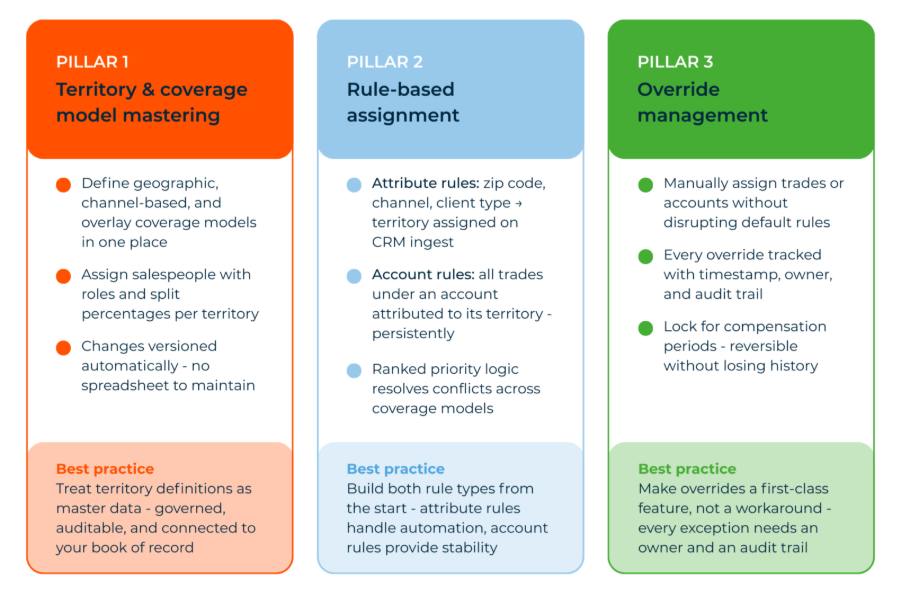
Regardless of firm size or distribution model, effective territory management rests on three capabilities: entity mastering, rule-based assignment, and override management. Getting all three right is what separates firms with accurate, scalable attribution from those still running on spreadsheets and institutional memory.
1. Territory And Coverage Model Mastering
Before any assignment logic can run, firms need a single authoritative place to define their territories and the coverage models that underpin them. This means capturing not just the territory itself - its name, geographic scope, and territory channel - but the territory members assigned to it, their roles, and where attribution splits between multiple individuals.
This is more complex than it sounds. A territory isn't just a list of zip codes or a country code. It needs to reflect how coverage actually works: whether a territory is geographic or non-geographic (channel-based, product-aligned, or an overlay like a national accounts team), which salespeople carry primary versus secondary attribution, and what the defined split percentages are between them.
When this master data is well-maintained and versioned, everything downstream - compensation calculations, AUM rollups by sales territory, territory channel reporting - becomes reliable. When it lives in a spreadsheet or CRM custom object that one person maintains, it becomes a single point of failure.
2. Rule-Based Territory Assignment
Manually assigning every new client or account to a territory is not scalable. The second pillar is a configurable rules engine that automates assignment as organisations and contacts flow into the system - typically from CRM.
There are two distinct rule types that a mature territory management framework needs to support:
Attribute-based rules evaluate the properties of an incoming entity - geography, zip code, territory channel, client type, distributor classification - and map it to the applicable territory and coverage model. When a new financial advisor account is onboarded with a specific channel flag and state, the rule set determines which territory it belongs to and which territory members are attributed, without manual intervention. These rules need to be configurable, ranked by priority, and capable of resolving conflicts when multiple territories could apply.
Account-level attribution rules operate differently. Rather than evaluating each entity individually, they establish that all trades and flows under a given account should be attributed to a specific territory - persistently. This is the mechanism that keeps attribution consistent over time without needing to reapply logic to every transaction. It's particularly important for institutional accounts and omnibus structures where individual-trade attribution would be impractical.
3. Override Management
No rule set is complete. Every distribution model has commercial arrangements, historical coverage decisions, or relationship-specific exceptions that don't fit cleanly into the standard logic. A global relationship director may cover a specific account that sits in another team's territory. A client acquired through a strategic relationship may need attribution that cuts across the standard channel classification.
Override capability allows a specific trade, account, or contact to be manually assigned to a territory, sitting cleanly on top of the default rules without disrupting the underlying model. Crucially, overrides need to be tracked, auditable, and temporally versioned - meaning they can be reviewed, locked for a compensation period, or reversed without losing historical accuracy.
Firms that lack a formal override mechanism end up with the same problem handled informally: CRM notes, email trails, and quarterly reconciliation calls that produce different answers each time.
What To Look For In A Territory Management Tool
The market for dedicated sales territory management software has evolved significantly, but most general-purpose tools were designed for simpler distribution models. When evaluating a platform - particularly for asset management - the key questions are:
- Does it connect territory assignment directly to your client master and book of record? Territory management in isolation doesn't solve attribution. The platform needs to propagate assignments downstream to AUM rollups, sales analytics, and compensation - automatically, not via scheduled exports.
- Can it handle non-geographic coverage models? Channel-based, product-aligned, and overlay territories are standard in modern distribution. Any tool that only supports geographic hierarchies will require workarounds immediately.
- Does it support split attribution? Multi-team coverage is the norm, not the exception. The tool needs to hold split percentages at the territory member level and apply them consistently across all outputs.
- Is there a proper override mechanism with audit trail? This is a sign of a system built for real-world complexity rather than clean-room assumptions.
- Does it have temporal versioning? When territories change, you need to restate history accurately - for compensation, for CBOR reconciliation, and for regulatory reporting. Systems without poly-temporal data models cannot do this reliably.
Platforms like Aiviq's are built specifically for this environment - with territory mastering, configurable rule sets, and override management all integrated within the same client data platform that drives CRM, AUM reporting, and sales analytics. The result is attribution that doesn't need to be reconciled across systems because it starts from a single, governed source of truth.
Common Territory Management Mistakes
Even firms with defined processes tend to make the same errors:
- Treating territories as CRM configuration rather than master data. CRM fields are easy to edit and rarely governed. Territory definitions need the same controls as client or product data.
- Skipping the rules engine and assigning manually. Manual assignment doesn't scale and creates inconsistency as teams grow and accounts multiply.
- No formal override process. Informal exceptions accumulate silently and surface only at quarter end when someone's compensation doesn't match expectations.
- Not versioning territory changes. Restructuring territories without historical versioning makes prior-period reporting unreliable and compensation disputes difficult to resolve.
- Conflating geographic territories with coverage models. A territory is a defined boundary; a coverage model describes how a team covers it. Firms that mix these concepts end up with territory structures that can't accommodate overlay teams or split coverage.
Final Thoughts
Sales territory management isn't a one-time configuration exercise - it's an ongoing operational discipline that needs proper tooling, governance, and integration with the systems that depend on it. The firms that get it right treat territory data with the same rigour as client data: mastered, versioned, auditable, and connected.
The payoff is significant: accurate compensation, reliable sales analytics, a clean book of record, and sales teams that spend their time on clients rather than spreadsheets.