The number of ELTIFs launched doubled in 2025. The sector has crossed €34 billion in AUM. EQT, Hamilton Lane, BlackRock, Schroders, and a growing roster of private markets managers have filed, launched, or publicly committed to ELTIF 2.0 vehicles as the primary structure for bringing private markets exposure to European retail and high-net-worth investors.¹
The regulatory problem has been largely solved. The distribution problem has not.
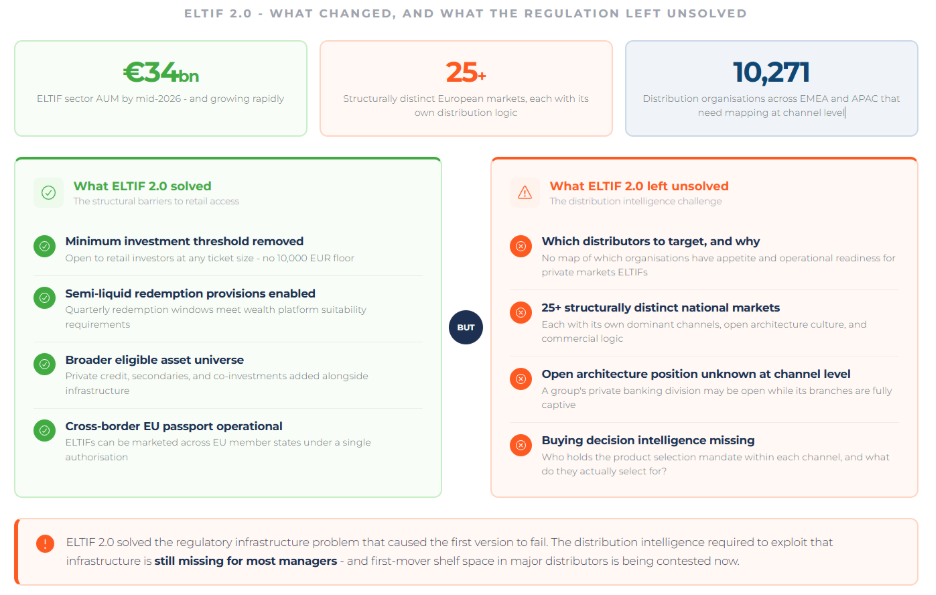
ELTIF 2.0 - which came into force in January 2024 after years of lobbying by the European investment management industry - removed the minimum investment thresholds, broadened the eligible asset universe, enabled semi-liquid redemption mechanisms, and simplified cross-border passport access. These changes addressed the structural reasons why ELTIF 1.0 failed to gain traction. In doing so, they have created something far more challenging: a market where the regulatory infrastructure is ready, but the distribution intelligence required to exploit it is missing for most managers.
What ELTIF 2.0 Changed, and What It Didn't
The original ELTIF framework, launched in 2015, was designed to channel long-term capital into infrastructure, SME lending, and real assets. In practice, it attracted minimal interest - minimum investment thresholds of €10,000 combined with illiquidity provisions made the structure unattractive for the wealth advisers who represent the primary gateway to HNW and retail capital in most European markets. Almost a decade after launch, fewer than 100 ELTIFs existed across the entire EU.
ELTIF 2.0 addressed that comprehensively. The removal of minimum investment thresholds opens the structure to retail investors at any ticket size. Semi-liquid provisions allow funds to offer quarterly redemption windows - close enough to liquidity for wealth platform suitability requirements. A broadened eligible asset universe now includes private credit, secondaries, and co-investments alongside the original infrastructure focus. Cross-border marketing through the EU passport is operational.
What ELTIF 2.0 did not solve is the question of where, precisely, a manager should be having distribution conversations. Europe has no single distribution market. It has twenty-five-plus structurally distinct ones, each with its own dominant channels, its own open architecture culture, and its own regulatory and commercial logic.
The Structural Complexity Asset Managers Face
Consider what fund distribution actually looks like across the markets where ELTIF 2.0 is most commercially relevant.
In Germany - Europe's largest fund market - retail fund flow is overwhelmingly routed through a three-pillar banking system. DekaBank serves the Sparkassen network; Union Investment serves the Volksbanken. DWS and Allianz Global Investors dominate institutional. These structures are deeply captive. A third-party manager launching an ELTIF targeting German retail investors needs to understand, at the granular level, which elements of this system have appetite for external alternative products - and which are closed books regardless of product quality.
In France, the bank and insurer captive structure is even more concentrated, with Amundi (Crédit Agricole), Natixis Investment Managers (BPCE), and AXA Investment Managers controlling major distribution relationships. Yet France also has a vibrant independent adviser and boutique channel that represents a genuinely accessible and commercially important opportunity for third-party ELTIF managers.
Italy runs on bancassurance and on the reti - the large tied adviser networks including Fideuram and Banca Generali and Mediolanum - that collectively represent some of the deepest private banking penetration in Europe. The reti are actively seeking high-quality private markets products for their HNW client base. They are also selective, structured buyers who require significant commercial relationship investment before they will list a product. Knowing which reti to prioritise, and at what scale band, is a commercially material question that a generic market map cannot answer.
In the Netherlands, institutional fiduciary managers - APG, PGGM, MN - control the largest pension pools in Europe relative to GDP and are sophisticated buyers of alternative credit and private equity. But they operate under entirely different procurement dynamics to the retail channels that ELTIF 2.0 primarily targets.
The UK, technically outside ELTIF scope but running a parallel LTAF regime, is adviser-led with over 4,000 registered IFA firms rolling up to a consolidating set of PE-backed networks and national firms - a structure that rewards data-driven targeting by geography, network affiliation, and managed portfolio mandate type.
The Open Architecture Question No One Is Answering
Across all of these markets, the most commercially important question for an ELTIF manager is not "how large is this distributor?" - it is "how open is this distributor to third-party alternative products?"
Open architecture exists on a spectrum. A distributor at the open end actively sources and lists external products across a broad universe of managers. A guided-open distributor maintains an approved list with active curation - accessible, but requiring investment. A restricted distributor has narrow shelf space for external products, usually in categories where their captive range is weak. A proprietary distributor is effectively a closed book.
Most asset managers do not have a systematic, evidenced view of where each of their target distributors sits on this spectrum - let alone how that positioning differs by product channel within the same group. A major Spanish banking group might have a guided-open approach in its private banking division while running a fully captive model through its branch network. Both are material AUM. Neither can be addressed with the same commercial strategy.
For ELTIF distribution specifically, open architecture scoring matters more than it does for traditional long-only products. The operational requirements for listing an ELTIF - suitability framework adjustments, adviser training, platform integration - mean distributors need to make an active decision to participate. Reaching the right ones early, with the right relationships, determines shelf space. Reaching the wrong ones wastes time and capital that early-mover advantage cannot afford to lose.
Distribution Intelligence as a Strategic Asset
European investment fund AUM reached a record €25.2 trillion in 2025, with UCITS already distributed across more than 50 countries outside the EU.² The infrastructure for cross-border distribution clearly exists at scale. The challenge for ELTIF managers is more specific: identifying, within thousands of registered distributors across each national market, which ones have the appetite and operational readiness for private markets products - and which channels within those organisations hold the buying decision and will actively champion a new ELTIF over competing products on their shelf.
That requires more than a CRM of existing contacts and a folder of market research reports. It requires a governed, maintained universe of the organisations asset managers sell to and through - their channel classification, their scale, their open architecture posture, and their addressable AUM - across every market where ELTIF distribution is commercially relevant.
The ELTIF boom is real. The €34 billion registered to date is a fraction of what the structure will hold at maturity, and the pace of launches in 2025 suggests the growth trajectory is accelerating. The managers who build distribution intelligence now - who know which Italian rete is ready for private credit, which German savings bank network is genuinely open, which French boutique channel to prioritise over the captive incumbents - will own the distribution relationships that define the next decade of European alternatives growth.
The door is open. The question is who knows which rooms to walk into.
Aiviq gives asset managers a structured, governed view of the organisations they sell to and through - across channels, markets, and open architecture posture. If you're building or refining your alternatives distribution strategy in Europe, we'd like to show you what that looks like in practice.
Sources
- Alternative Credit Investor, Number of ELTIFs launched doubled in 2025 as sector hits €34bn AUM, April 2026
- EFAMA, Fact Book 2026: Trends in European Investment Funds, 24th Edition, 2026