Private credit has crossed $3.5 trillion in global AUM.¹ It is now the fastest-growing segment in private markets - outpacing private equity fundraising for the third consecutive year - and it is moving aggressively into the wealth channel. Direct lending, infrastructure debt, asset-backed finance, and specialty credit are being packaged into interval funds, BDCs, and semi-liquid evergreen vehicles designed for high-net-worth and mass-affluent investors who could not access the asset class a decade ago.
The capital formation story is well understood. The distribution infrastructure story is not - and it is quietly becoming one of the most significant operational constraints in the industry.
Why Private Credit Is Uniquely Hard to Distribute
Every alternative asset class carries data complexity. Private credit carries it at a different order of magnitude.
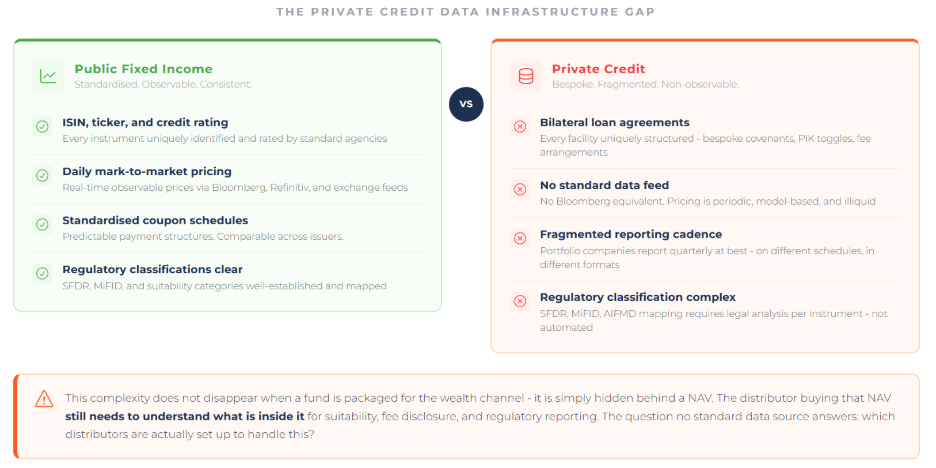
Public fixed income has tickers, ISINs, credit ratings, standardised coupon schedules, and daily pricing through Bloomberg or Refinitiv. Private credit has none of these. Every loan in a direct lending portfolio is a bilateral agreement with bespoke documentation: its own covenants, PIK toggles, fee structures, security packages, and jurisdiction. A single middle-market credit fund may hold exposure to dozens of portfolio companies, each structured differently, each reporting on a different cadence, and none of them observable through any standard data feed.
That complexity does not disappear when a fund is packaged for the wealth channel - it is simply hidden behind a NAV. The distributor buying that NAV - whether an IFA network, a private bank, a platform, or a bancassurance group - still needs to understand what is inside it for suitability purposes, fee disclosure, and regulatory reporting. They need to categorise it correctly in their systems, map it to the right regulatory classification (SFDR Article 8 or 9, MiFID product governance, AIFMD), and ensure their advisers can explain it to clients.
The question that almost no distribution data source can answer clearly is: which distributors are actually set up to do this?
The Wealth Channel Imperative - and the Targeting Vacuum
The case for accessing wealth is not new. Global wealth management AUM runs to tens of trillions of dollars, private credit's penetration of it remains tiny, and every major private credit manager has a distribution strategy targeting this channel. What has changed in 2025 and 2026 is the urgency. Semi-liquid vehicle structures have matured. Regulatory frameworks - the UK LTAF, the EU's ELTIF 2.0 regime, the US interval fund structure - have made it operationally feasible to offer private credit products to retail and HNW investors at scale. First-mover shelf space in major distributors is being contested now.
Yet most private credit managers approach distribution targeting with inadequate data. They hold sales contacts at a handful of known distributors. They have a broad sense of which market segments have demand. They do not have a systematic view of which of the thousands of registered distribution organisations across the markets they operate in - banks, wealth platforms, adviser networks, DFMs, pension intermediaries - have appetite for private credit specifically, which channels within those organisations hold the buying decision, and what proportion of their AUM is genuinely accessible to third-party alternative credit products.
The wealth channel's appetite for private credit is clear but largely untapped. AIMA's analysis shows retail and mass-affluent investors currently represent just 24% of global private credit AUM - a share widely expected to grow as semi-liquid structures mature and regulatory frameworks like ELTIF 2.0 and the UK's LTAF open the asset class to a broader investor base.² Yet distribution reach into that channel remains the critical bottleneck. The managers who can systematically identify which wealth distributors are operationally set up for private credit, and which are genuinely open to third-party allocation, will access that growth faster and more efficiently than those relying on existing relationships and intuition alone.
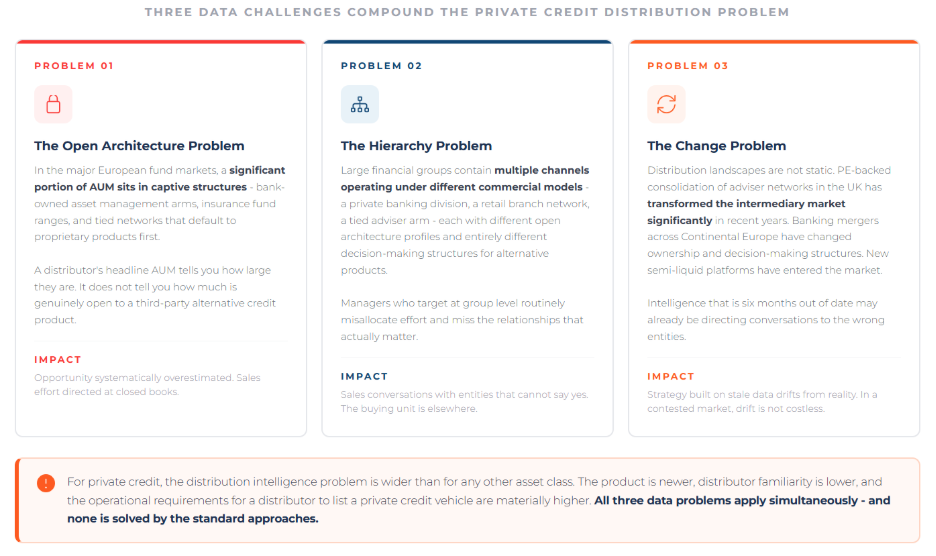
For private credit, the distribution intelligence problem is wider than for any other asset class. The product is newer, distributor familiarity is lower, and the operational requirements for a distributor to list a private credit vehicle - suitability frameworks, adviser training, platform integration - are materially higher.
The Structural Data Problems
Three specific data problems compound the challenge for private credit managers building wealth distribution strategies.
The open architecture problem. In the major European fund distribution markets, a significant portion of AUM sits in captive structures - bank-owned asset management arms, insurance company fund ranges, and tied adviser networks that default to proprietary products. A distributor's headline AUM tells you how large they are. It does not tell you how much of that book is genuinely open to third-party alternatives. For private credit, where distribution readiness requires operational investment by the distributor (system integration, adviser training, suitability framework development), the effective addressable universe is considerably smaller than headline numbers suggest.
The commercial versus legal hierarchy problem. Large financial groups often contain multiple distribution entities operating under different commercial models. A major European banking group might own a retail bank branch network, a private banking division, and a tied adviser network - three channels with materially different open architecture profiles and entirely different decision-making structures for alternative product selection. Managers who target at the group level, rather than the channel level, routinely misallocate sales effort and miss the relationships that actually matter.
The change problem. Distribution landscapes are not static. PE-backed consolidation of adviser networks in the UK has transformed the intermediary market significantly over the past five years. Banking mergers across Continental Europe have changed the ownership structure of major distributors. New platforms have entered the semi-liquid product space. A distributor intelligence view that is six months out of date may already be directing sales conversations to the wrong entities or the wrong contacts.
What Private Credit Distribution Intelligence Requires
Managing private credit distribution effectively requires the same foundation that managing any complex, multi-channel sales process requires: a governed, maintained, and accurate view of who you are selling to and through.
That means understanding distributor identity at the right granularity - not the legal group, but the commercial unit where the buying decision sits. It means knowing channel type (private bank, adviser network, platform, bancassurance, institutional pension), scale, and open architecture posture. It means modelling the genuinely addressable AUM - accounting for what is captive and what is not - so that opportunity sizing is grounded rather than aspirational. And it means keeping that view current, because a market intelligence snapshot from last year's roadshow season is already behind the structural shifts happening in the distribution landscape today.
For managers building private credit distribution strategies for the wealth channel, the data infrastructure question is not a back-office concern. It is a strategic prerequisite. The firms who answer it well will gain shelf space in the right distributors faster and with lower cost. The firms who rely on relationship memory and infrequent market mapping will find themselves in distribution conversations they cannot win, with distributors they should never have prioritised.
Private credit's operational complexity is well documented. Its distribution intelligence problem is not - but the managers building for the wealth opportunity are discovering it the hard way.
Aiviq gives private markets managers a structured, governed view of the distribution landscape - who the right organisations are, how open they are to third-party alternatives, and where the genuinely addressable opportunity sits, at the channel level. If you're building a wealth distribution strategy for private credit, we'd like to show you what that looks like.
Sources
- AIMA, Global Private Credit Market Reaches US$3.5 Trillion AUM, 2025
- AIMA, Global Private Credit Market Reaches US$3.5 Trillion AUM, 2025 (retail/institutional AUM split)