Modern asset management operates in an environment of unprecedented data complexity. Distribution channels have multiplied. Regulatory obligations expand annually. Client relationships span multiple vehicles, geographies, and product structures that legacy systems were never designed to handle. Yet most firms continue relying on fragmented spreadsheets, siloed systems, and manual processes that create operational friction at every level of the organisation.
The cost of this fragmentation doesn't just appear in the financial close. It bleeds across the entire firm - sales teams lack real-time client visibility, compliance teams struggle with distributor oversight, operations teams waste resources on manual account matching, and commercial teams make decisions based on incomplete information. The real question isn't whether asset managers need a modern client data platform - it's how long they can afford to wait before implementing one.
What Separates a True Client Data Platform from Legacy Systems
Not all data solutions are created equal. Many firms have invested in enterprise data platforms or implemented point solutions that address one problem at a time. These approaches miss the fundamental challenge: client data in asset management isn't fundamentally a technology problem - it's a data architecture problem that requires foundational rethinking.
A true client data platform for asset management must do four things simultaneously:
1. Consolidation of fragmented sources into a unified architecture
Your clients don't care that you have 47 different transfer agents, 12 custodian feeds, and distribution data arriving in seven different formats. They care that you know who they are, what they own, and what they're paying. A modern platform ingests from hundreds of global data sources - fund accountants, transfer agents, platforms, custodians, distributors - and standardises everything into a unified model. This isn't just ETL engineering; it's industry-specific data mapping that understands the peculiarities of mutual funds, ETFs, separate accounts, private markets, and everything in between.
2. A single authoritative record for critical business entities
This is the Client Book of Record (CBOR) - a complete, trusted view of client economics across all vehicles, agreements, and sales channels. But CBOR isn't a database dump; it's a curated, governance-controlled collection of five interrelated data masters: AUM & Flow (understanding what clients own and how it's changing), Accounts (knowing which accounts belong to which clients), Agreements (mastering all commercial terms and fee arrangements), Client Master (creating golden records with organisational hierarchies and contact information), and Product Master (standardising product definitions across the firm).
3. Automation of the complex matching and enrichment work that currently consumes thousands of hours annually
Client matching should be solved by now. Yet most firms employ teams of people manually matching accounts to clients, reconciling naming inconsistencies, and resolving hierarchical relationships. Modern platforms use AI-powered algorithms to achieve accuracy rates that manual processes could never sustain at scale. Beyond matching, enrichment layers cleanse data, infer missing attributes, and maintain data quality automatically as new information arrives.
4. Serving multiple stakeholders simultaneously
Your CFO needs accurate, timely financial data for reporting. Your CDO needs stewarded CRM data for sales and marketing. Your COO needs operational transparency for compliance. Your CTO needs cloud-native architecture that fits within enterprise infrastructure. A fragmented point-solution approach solves for one stakeholder at the expense of others. A true client data platform is built from the ground up to serve the entire organisation.
The Operational Impact Across the Firm
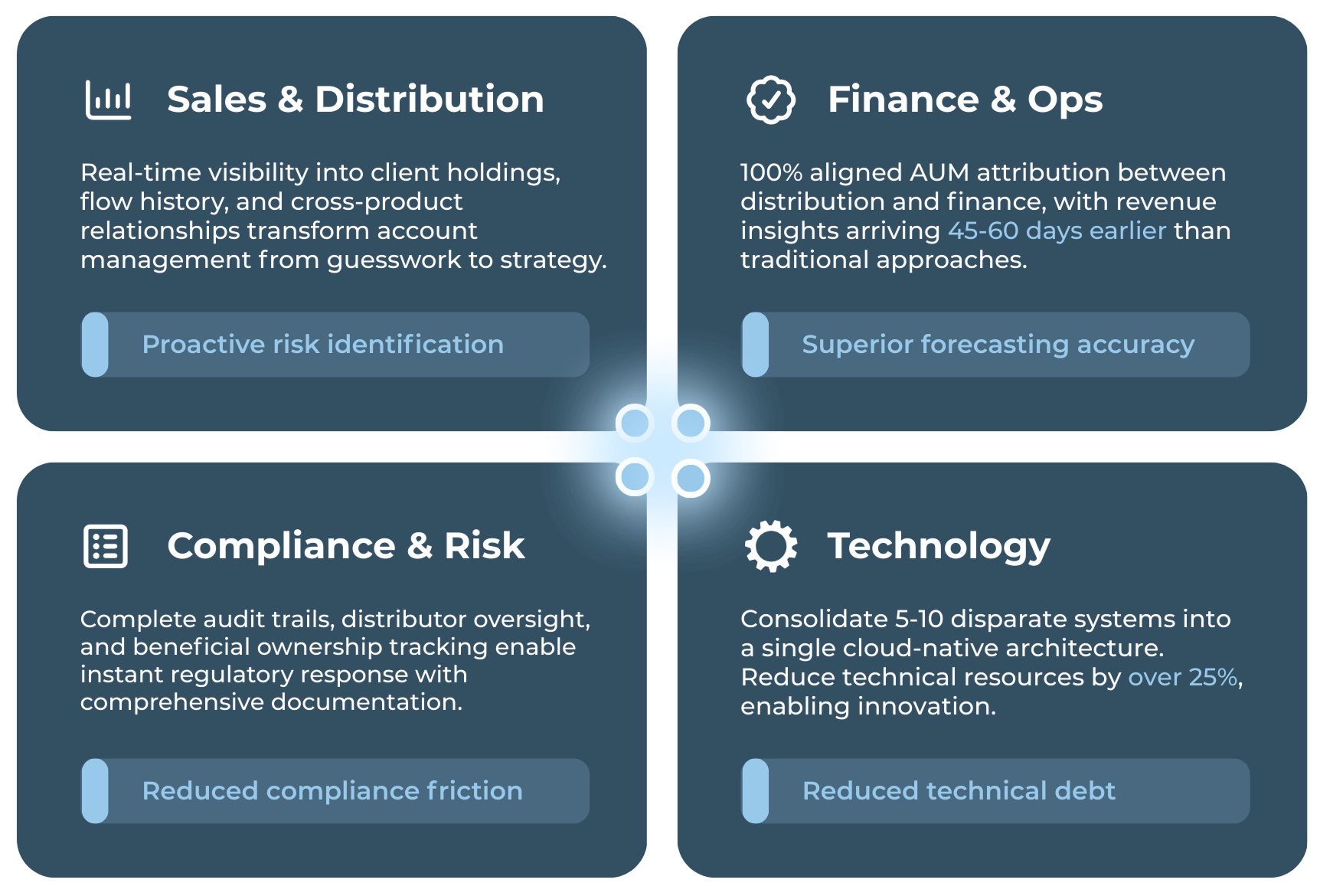
The benefits of implementing a modern client data platform ripple across asset management operations in ways that spreadsheet-based approaches simply cannot match.
Sales and distribution gain real-time client visibility. When sales teams have access to current client holdings, flow history, and cross-product relationships, account management transforms from guesswork to strategy. Rather than discovering after quarter-end that a client concentrated their holdings in a single product, teams can identify these risks in real-time and proactively engage. One EMEA-focused manager reported that sales teams finally have visibility of underlying clients and can make informed account management decisions - something that sounds basic but had been impossible under their previous fragmented infrastructure.
Finance and operations align on a single version of truth. When distribution operations and finance report different AUM numbers, client profitability analysis becomes impossible. Modern platforms eliminate this friction by ensuring that AUM attribution between distribution and finance is aligned, with revenue and rebate insights available 45-60 days earlier than traditional approaches. This enables superior forecasting, more accurate commercial decision-making, and fewer surprises during financial close.
Compliance and risk teams gain visibility they previously couldn't achieve. Distributor oversight, beneficial ownership tracking, and fee disclosure compliance all require understanding your entire distribution chain. A centralised platform maintains complete audit trails, tracks changes over time, and enables compliance teams to respond to regulatory requests with comprehensive documentation rather than reconstructing decisions from scattered emails and systems.
Technology teams reduce technical debt while enabling innovation. Most large asset managers operate 5-10 different systems attempting to solve the same core problem: understanding client data. This fragmentation creates maintenance burden, integration complexity, and competing versions of truth. A modern platform consolidates these disparate systems into a single cloud-native architecture. One global asset manager reduced technology resources supporting client data initiatives by over 25%, enabling downstream innovation and scaling.
The AI Advantage: Competing on Intelligence, Not Infrastructure
The data foundation matters more now than ever because AI capabilities are emerging that can only function on clean, structured, authoritative data. Firms without robust client data infrastructure are locked out of competitive advantages that AI now enables.
Consider what becomes possible when you have a unified, accurate, constantly updated view of your global client relationships:
- Predictive retention risk modelling that identifies which clients are most likely to redeem before they do, enabling proactive engagement rather than reactive firefighting. Rather than discovering client departures during quarterly meetings, relationship managers receive alerts flagging retention risk weeks in advance.
- AI-powered growth opportunity identification that surfaces strategic actions and client propensity insights, helping sales teams focus effort on highest-potential opportunities rather than intuition-based prospecting. This transforms client servicing from reactive to strategic.
- Intelligent anomaly detection across thousands of daily data files that identifies processing issues in real-time and recommends remediation. This eliminates the discovery lag that previously meant problems went unnoticed until manual reconciliation revealed them.
- Automated account matching and mastering that continuously maintains attribution accuracy at scale as client bases grow. The manual matching work that once consumed entire teams now runs automatically while maintaining accuracy that exceeds what manual processes ever achieved.
These aren't theoretical capabilities - they're already deployed in leading firms. The competitive gap between firms with modern client data platforms and those relying on fragmented systems will only widen as AI capabilities mature.
Building Your Foundation: A Realistic Implementation Path
Implementation shouldn't be paralysing. A well-designed client data platform should have clear phase gates and business value appearing early in the process. The approach: start with your highest-impact use case (often AUM & Flow reporting or account attribution), validate the methodology with key stakeholders, then expand systematically to additional data domains and regions.
Your team provides requirements definition, sample data, testing participation, and business acceptance sign-off. The platform provider handles technical architecture, connector configuration, deployment, and ongoing support. The result is a scalable foundation that improves as it grows, rather than breaking under increasing complexity.
The Question Isn't Whether - It's When
Asset managers operating with fragmented client data face three converging pressures: increasing complexity in distribution channels and product structures, rising regulatory requirements, and emerging AI capabilities that require clean, structured data to unlock competitive advantage.
Firms that address these challenges head-on now gain a substantial advantage. Those that delay face increasing operational friction, rising costs, and vulnerability to competitors that have already built their modern data foundation.