Ask the finance team at most asset managers whether they know the net revenue from their top twenty distributor relationships - not at quarter-end, not after a reconciliation run, but today - and the honest answer is almost always no.
Not because the data does not exist. It does, in some form, scattered across agreement documents, fee schedules, TA statements, and AUM reports that nobody has systematically connected.
Not because leadership does not want it. When Aiviq asked a cross-section of global asset managers what single question their executive leadership would most want to answer if the technical prerequisites were in place, the answers were unanimous: full revenue transparency, at any level of the business, without manual assembly.
The problem is structural. Most firms have spent years building robust AUM and flow infrastructure - and almost no time building the commercial intelligence layer that sits on top of it. Agreements are captured across certain tools. Financial terms may be instructed or captured manually in spreadsheets or SharePoint. Rebate calculations happen somewhere. But none of these sit in the same governed environment, connected to each other and to the AUM data that gives them commercial meaning.
The result is a firm that knows its assets but not its economics.
The Gap Between Data and Intelligence
There is an important distinction between having agreement data and having revenue intelligence - and most asset managers are stuck on the wrong side of it.
Having agreement data means fee schedules exist. Terms have been captured in a spreadsheet, a PDF repository, a CRM field, or a transfer agent system. Somebody knows what was agreed. In most firms, this is broadly true, even if it is fragmented and inconsistently maintained.
Revenue intelligence is something different. It means knowing, at any point in time, what those terms are worth - by client, by fund, by channel, by market - and being able to connect that to actual AUM and flow data to produce a live view of estimated net revenue, profitability, and commercial exposure across the full book of business.
The gap between the two is not a small one. In Aiviq's customer forum research, not a single participating firm could answer all six basic revenue intelligence questions we posed - including whether they could produce net annualised revenue from year-to-date net flows by client, or agreement-level annualised revenue for each month of holdings over the past two years. These are not exotic analytical requests. They are table-stakes commercial questions that finance and sales leadership ask regularly - and that require significant manual effort to answer because the underlying data is not connected.
Why This Matters More Than It Used To
The commercial intelligence gap in agreements management has always existed. What has changed is the cost of living with it.
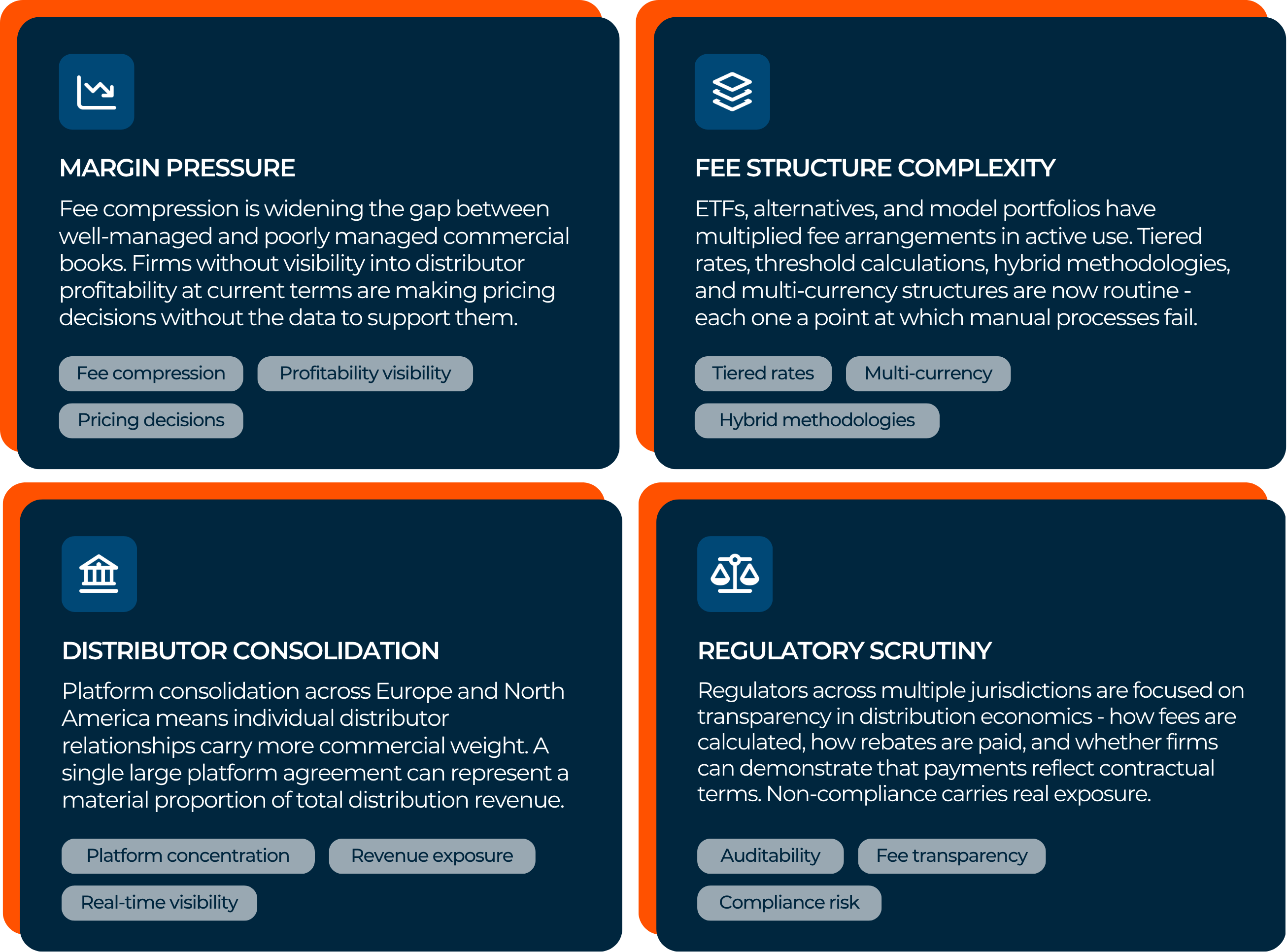
- Margin pressure is intensifying. As fee compression continues across the industry, the difference between a well-managed commercial book and a poorly managed one is growing. Firms that cannot see which distributor relationships are profitable at current terms - and at what AUM level they become uneconomical - are making pricing and retention decisions in the dark. The margin for error is smaller than it was five years ago.
- Fee structures have grown more complex. ETFs, alternatives, model portfolios, and evolving distributor expectations have multiplied the variety of fee structures in active use. Tiered rates, threshold-based calculations, hybrid methodologies, time-based reversions, and multi-currency arrangements are no longer exceptions - they are routine. Every additional layer of complexity is another point at which manual processes fail and revenue intelligence degrades.
- Distributor consolidation is accelerating. Platform and distributor consolidation across Europe and North America means that individual distributor relationships now carry more commercial weight. A single large platform agreement can represent a material proportion of total distribution revenue. The stakes of not having accurate, real-time visibility into that relationship's economics have never been higher.
- Regulatory expectations are rising. Regulators across multiple jurisdictions are increasingly focused on the transparency and accuracy of distribution economics - how fees are calculated, how rebates are paid, and how firms can demonstrate that what is being paid reflects what was contractually agreed. Firms that cannot produce an accurate, auditable revenue calculation for any given agreement on demand are carrying compliance exposure alongside commercial risk.
What Revenue Intelligence Actually Enables
The commercial case for building proper revenue intelligence on agreements data goes well beyond eliminating billing errors - though that alone is meaningful. At scale, even small systematic variances between what should be paid and what is calculated compound quickly across hundreds of agreements and billions in AUM.
The more significant opportunity is in how the business makes commercial decisions.
- Fee negotiations become data-driven. When a sales team can see the current net revenue yield of a distributor relationship, model the impact of a proposed rate change, and understand the break-even AUM threshold for that relationship at different fee levels - all before entering a negotiation - the quality of that negotiation changes. Today, most of that analysis happens after the fact, if at all.
- Client tiering reflects commercial reality. Segmentation built on AUM alone misses the commercial picture. A large-AUM client on discounted terms may be less profitable than a mid-size client on standard rates. When revenue intelligence is available at client level, tiering and coverage decisions can be grounded in actual economics rather than assets alone.
- FP&A gains a live revenue feed. Finance teams running quarterly forecasting cycles on agreement revenue are working with a significant time lag. Daily estimated revenue - updated as flows and AUM positions change - gives FP&A a continuous forward view rather than a periodic snapshot. Cash accrual forecasting, liability management, and revenue recognition all benefit.
- Profitability outliers become visible. Uneconomical terms are a known industry problem - arrangements agreed at AUM levels or under market conditions that no longer apply, where the commercial case for the current rate has eroded. Without a system that surfaces these systematically, they persist. With revenue intelligence at scale, outliers are visible and can be addressed proactively.
The Integration Question
None of this is achievable without resolving the integration question - and this is where the work is harder than it looks.
Agreements data and AUM and flow data typically live in separate systems, owned by different teams, on different technology stacks. Connecting them is not simply a technical exercise. It requires a shared entity model - a common representation of clients, accounts, and products that both systems can reference - and a governance process that keeps the two in sync as the business evolves.
This is why point solutions rarely deliver on the revenue intelligence promise. A fee billing platform that calculates accurately but cannot connect to live AUM data produces accurate calculations on stale inputs. An AUM platform that tracks flows precisely but has no awareness of the terms that govern them cannot produce net revenue figures without a separate, manual integration step.
The firms that have solved this have done so by treating agreements and AUM data as two layers of the same platform rather than as separate problems to be solved by separate tools. The legal entity model is shared. The account identifiers are consistent. When a new account opens, it is linked to the relevant agreement and begins calculating from the first transaction. When AUM moves, estimated revenue updates automatically.
That integration is what transforms agreement data from a compliance record into a commercial intelligence asset.
Where to Start
For firms where revenue intelligence on agreements data is currently limited, the path forward does not require replacing everything at once.
The highest-value first step is almost always structured terms capture - moving financial terms from documents and spreadsheets into a governed, structured data model. This unlocks calculation accuracy and creates the foundation that every downstream intelligence capability depends on. It also surfaces the inventory of what the firm actually has in place: the number of agreements, the variety of term structures, the gaps where terms have not been captured or are out of date.
The second step is the integration to AUM data - establishing the connection between terms and holdings that makes estimated revenue a live output rather than a periodic exercise.
The third is building the intelligence layer on top: reporting, profitability analysis, MFN monitoring, scenario modelling, forecasting. This is where commercial value becomes directly visible to leadership - but it only holds up if the first two steps are done properly.
The firms that have built this capability report a consistent set of outcomes: material reduction in billing error rates, faster and more accurate revenue recognition, and - perhaps most valuably - the ability to answer commercial questions that were previously unanswerable without significant manual effort.
.png)
Aiviq TermsCloud provides structured agreement and financial terms management, automated fee and rebate calculation, and daily net revenue intelligence as part of the Aiviq Client Data Platform - connecting agreements data directly to mastered AUM and flow data for a complete view of client economics.