
A client calls with a straightforward question for their relationship manager. Two representatives respond, and neither was aware the other held the account.
No individual is at fault in this scenario. The territory rule that should have prevented it was distributed across a spreadsheet tab, several CRM custom fields, and the recollection of someone who left the firm eighteen months earlier. When territory logic is not grounded in a governed golden record, coverage governs itself unreliably, typically at the moment it matters most.
Territory logic is simple until it has to survive change
Most sales territory models begin cleanly. A representative is assigned a book of clients. A region maps to a team. On the first day, the structure works as intended.
The rules rarely keep pace with what follows:
- A representative leaves, and their book is divided among three colleagues, each inheriting a partial and undocumented view of the accounts they now cover
- A new fund launches, and no one formally determines whether it falls under an existing regional split or requires its own coverage logic
- An active and a passive team each have a legitimate claim to the same client group, with no defined rule for which takes precedence when the claims conflict
- A representative holds dual registration across broker-dealer and RIA channels, and the client relationship is attributed differently depending on which system is consulted
These are not edge cases. They represent the ordinary lifecycle of a distribution business. The underlying issue is that most territory logic was designed to describe a single moment in time, then left to degrade as the business continued to change around it.
The rules are not missing. They are simply ungoverned.
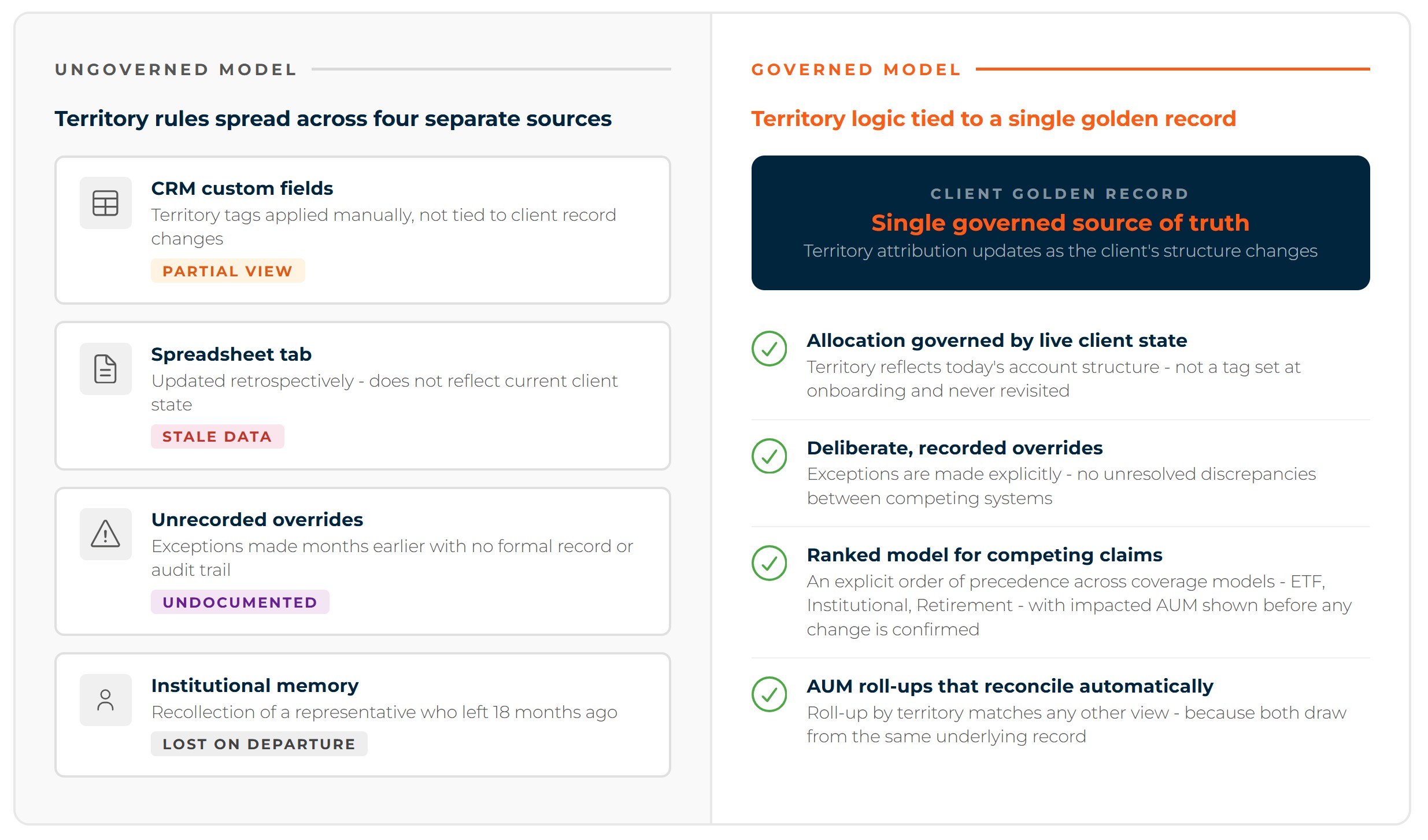
Most Heads of Distribution and Sales Operations leaders, when asked, will confirm that territory rules exist. The answer becomes less certain when the follow-up question is where those rules are held: partly within the CRM, partly in a spreadsheet updated retrospectively, and partly in an override made months earlier that was never formally recorded.
This is not an absence of rules. It is the absence of a single governed source that ties territory logic directly to the client's golden record, so that coverage updates as the client's structure changes, rather than depending on someone to update it separately and reliably.
The result is a coverage model that is technically defined but operationally inconsistent, in which two representatives can each appear correct according to the system they are viewing.
The cost of ungoverned coverage
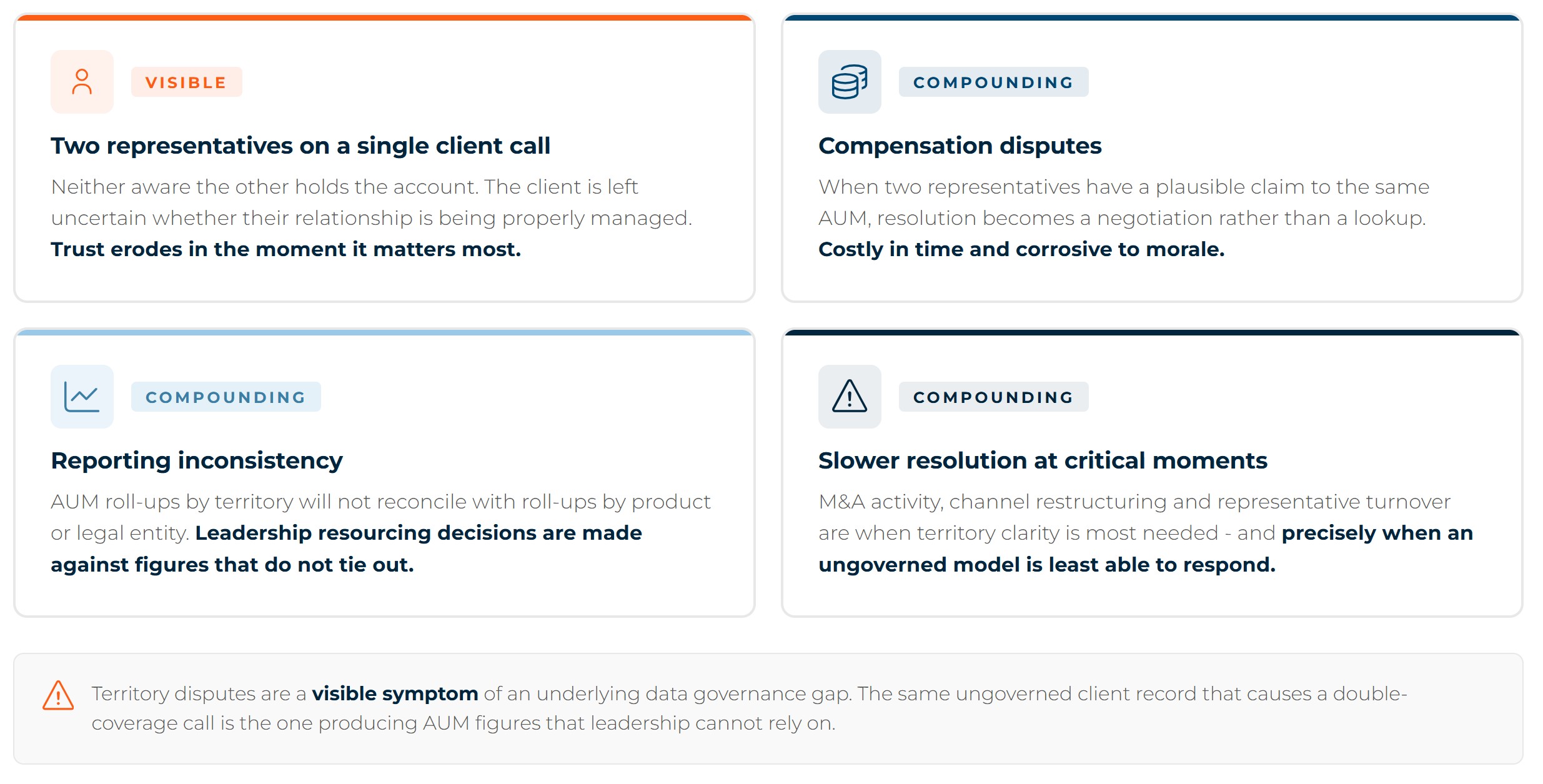
The most visible cost is the immediate one: two representatives on a single call, and a client left uncertain whether their relationship is being properly managed. The less visible costs compound beneath it.
Compensation disputes. When two representatives have a plausible claim to the same AUM, resolution becomes a negotiation rather than a lookup, which is costly in time and corrosive to morale.
Reporting inconsistency. Without governance of territory attribution at the golden record level, AUM roll-ups by territory will not reconcile with roll-ups by product or legal entity, meaning leadership decisions on resourcing are being made against figures that do not tie out.
Slower resolution precisely when clarity matters most. M&A activity, channel restructuring and representative turnover are the moments at which territory clarity is most needed, and precisely the moments at which an ungoverned model is least able to respond.
Firms that have quantified the cost of ungoverned client data stewardship place the figure in the millions annually per business line once reporting inefficiency, manual reconciliation and compliance oversight are accounted for. Territory disputes are a visible symptom of the same underlying gap.
What a governed territory model requires
The solution is not a better spreadsheet or a stricter CRM workflow. Territory management is, by nature, a layer built on top of client data. The question is whether that layer is built on a governed golden record and consistent client matching, or left to sit apart from it, reconciled by hand. This requires the following:
Territory allocation governed by the golden record, not a static account tag. Territory rules are evaluated against the client's current, active state, so a trade or account is attributed to whichever territory applies today. When a client's structure changes, whether through a merger, a new account or a shift between institutional and intermediary channels, that attribution should reflect the client's current position rather than continuing to carry an assignment that was never revisited.
The ability to override a previous attribution. Exceptions are inevitable. When an attribution needs to be corrected, that correction should be made deliberately, rather than left as an unresolved discrepancy between two systems that both claim to be right.
AUM roll-ups that reconcile automatically by territory. Where territory is a governed attribute of the golden record rather than a manual tag, roll-ups by territory should match roll-ups by any other view of the same data, because both draw from the same underlying record rather than a separate reporting layer.
A ranked model for resolving competing claims. Coverage Model Ranking lets a firm set an explicit order of precedence across coverage models, such as ETF Business, Institutional, Retirement or Models, so that when a client or account could plausibly sit under more than one, the ranking determines which takes primary sales attribution. Reordering that ranking is not applied blindly either: the impacted AUM and net flow are shown before the change is confirmed, so no one is updating attribution across a client base without first seeing what it moves.
This distinguishes a territory model that describes how the business was organised on the day it was built from one that continues to describe the business accurately as it evolves.
Aiviq's Client Master governs sales territory management as a native part of the client entity model, covering territory allocation, maintenance, override rules and AUM roll-ups, built on the same golden record used across sales, finance and client servicing. No separate reconciliation layer. No spreadsheet standing in for a system.