Most client data models start with the organization. In most markets, the adviser behind an account is not visible in the data, so matching stops at the firm. In US wealth, adviser-level identifiers such as CRD numbers make that next layer possible.
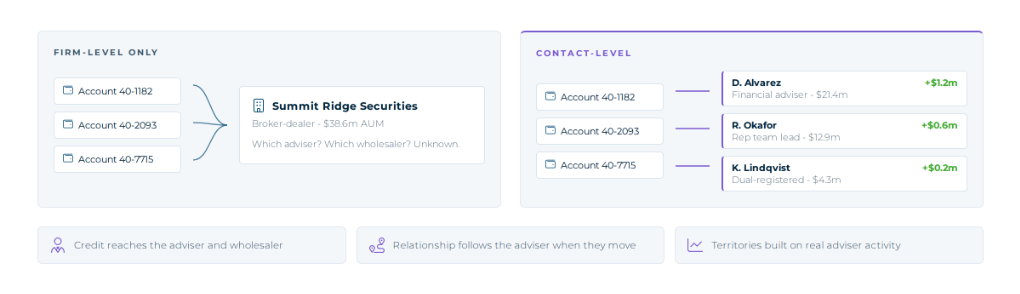
That matters, because the firm is where the assets are custodied, but the adviser is who decides where they go. An account matched only to a wirehouse or independent broker-dealer tells you which firm holds the money, but not which of its thousands of financial advisers you should be crediting, covering or paying attention to.
Why firm-level matching breaks down
Three characteristics of the US market make organisation-level matching insufficient on its own:
- Advisers carry their own regulatory identity. A financial adviser holds a CRD number that follows them across firms, which makes the individual - not the branch - the durable identity.
- Advisers move, and bring books with them. When an adviser changes firm or joins an independent network, their clients' accounts are typically re-papered at the new firm under new account numbers. A firm-level match treats these as new, unrelated accounts. A contact-level match links them back to the same adviser, so the relationship history carries over.
- Teams and dual affiliations are common. Advisers work in rep teams and partnerships, and some are registered with more than one firm. Credit needs to reach the people who actually drive the flow.
For sales and marketing teams, the consequence is practical. Wholesalers are compensated and targeted at adviser level. Territory design, campaign measurement and pipeline all depend on knowing which adviser an account belongs to.
What contact-level matching actually means
Contact-level matching resolves each account to an individual on your contact master, as well as to the organization they are affiliated with. The organization view still matters for hierarchy and group reporting. The contact view adds the layer where US distribution is actually managed.
Doing this at scale requires two things working together.
The first is deterministic rules for the clear cases. Where an account carries a CRD identifier that resolves to exactly one active contact, the match can be made automatically, recorded against the rule that produced it and re-evaluated as source data changes.
The second is a way to handle everything else - accounts with partial names, missing identifiers, team names written in different orders, or branch details that only point in the right direction.
Where AI helps, and where it should not decide
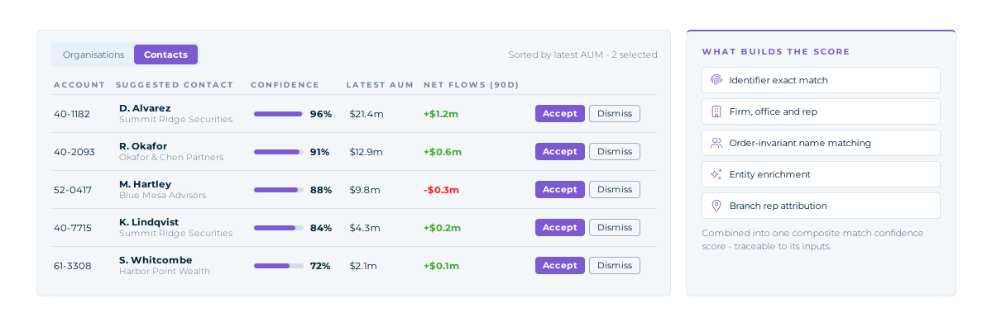
This is where Aiviq Intelligence matching suggestions come in. Rather than leaving unmatched accounts in a manual queue, the platform proposes the most likely contact for each one, with a confidence score to show how strong the match is.
Each suggestion carries a confidence score built from several signals: exact identifier matches, firm, office and rep relationships, name similarity across several algorithms to accommodate differences e.g., in word order, spelling and formatting ("Smith & Jones" versus "Jones & Smith", "Jon" versus "John", "Smith Wealth Group" versus "Smith Wealth"), entity enrichment and branch-level attribution. Because the score is built from several signals, it reflects more than a single data point.
The decision stays with your team. Suggestions are accepted or dismissed by a person, individually or in bulk, and every accepted and dismissed suggestion remains visible in its own view. AI proposes, humans decide.
Prioritise by materiality, not by queue order
Not every unmatched account deserves the same attention. In Aiviq Intelligence, each suggestion sits alongside its commercial context: the provider, latest AUM and 90-day net flows for the account. Teams can work on the accounts that move the numbers first, rather than simply working from the top of a list.
The detail needed to make a decision - the source account, its associated entities and the suggested contact - should be available in the row itself, so reviewers are not switching screens to confirm a match.
One approach for organizations and contacts
Firms rarely operate in a single market. The same team may match European accounts at organization level and US accounts at contact level. When both views behave the same way - the same filters, the same row detail, the same bulk actions, with a simple toggle between them - the learning curve is shorter and the matching discipline is consistent across the estate.
What contact-level matching unlocks
- Accurate sales attribution to the adviser and the wholesaler who covers them
- Territory and coverage design built on real adviser-level activity
- Campaign and marketing measurement tied to individuals, not just firms
- Continuity when advisers move, because the relationship follows the person
How Aiviq approaches it
Within the Aiviq Client Master, contacts are modeled with their role, regulatory identity and affiliations, including dual listings across firms. Deterministic rules resolve the unambiguous matches, Aiviq Intelligence suggests the rest with an auditable confidence score, and your stewards make the final call - with full lineage behind every decision.