Ask any asset manager how a distribution agreement is written and the answer is almost always in ranges. "All A shares across the Global Equity umbrella." "Every institutional share class except the money market fund." "The full retail range, at 35 basis points."
Now ask how that same agreement is stored in the systems that calculate trailer fees, rebates and, management fee revenue. In most firms, the answer is a list of products against each term - share class by share class, keyed in manually.
That gap between how agreements are structured across key product groups and how they are maintained in systems today is one of the most persistent, and least visible, costs in asset management distribution. It shows up as hours spent linking share classes to terms every time an agreement is onboarded, additional hours adding funds and share classes to live agreements every time a new product launches, and revenue that goes unbilled or unrecognized if a link is missed or not updated. Product groupings close that gap.
Agreements reference product ranges, but current tools do not provide the functionality to define and manage them
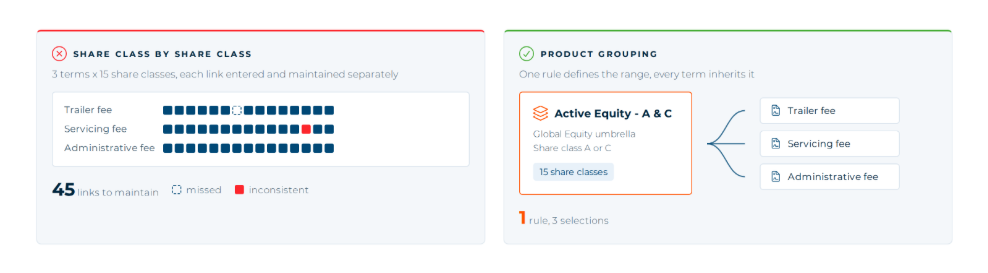
Most agreements and terms tooling do not give teams the ability to define and centrally manage their product ranges to later reuse when linking terms to products. A single platform agreement might carry three financial terms - a trailer fee, servicing fee, and an administrative fee. If each term applies to the same product range that consists of 15 share classes, that is the equivalent of 45 individual links required to set up across the terms, for a single agreement.
Multiply that across hundreds of agreements and the problem stops being administrative, it becomes structural. The commercial intent - "this term covers my Active Equity range" - can never be defined and managed in most tools and systems today.
Where the cost really sits
The most significant cost is time and maintenance, creating operating model inefficiencies, and this is larger than most firms measure. The less obvious costs show up in revenue, payments and audit. Operational capacity. Every agreement onboarded means hours spent finding and linking share classes, term by term. Every fund launch adds a backlog of links to update across live agreements, and every counterparty query brings rework. That is capacity operations teams cannot spend elsewhere, and it grows with every new agreement and every launch.
- Silent gaps at fund launch. When a new share class launches into a range that is already covered by a live agreement, nothing in a list-based model tells anyone it should be linked. The term simply does not know it exists. Revenue that is contractually due goes unbilled or unrecognised until someone spots the discrepancy, often months later, by which point past periods need recalculating and the conversation with the counterparty is harder.
- Inconsistency across terms. The same range, entered by different people across different terms, drifts. One term includes a hedged share class, another does not. Neither is obviously wrong until a counterparty queries an invoice or a rebate statement fails to reconcile, and the relationship takes the strain.
- Sign-off without context. When finance teams review billing or rebate payments, they see a flat list of share classes per term with no reference to the range it was meant to represent. Verifying coverage becomes a manual, line-by-line exercise, and errors are more likely to reach a rebate payment or a client invoice.
Product groups to streamline term links
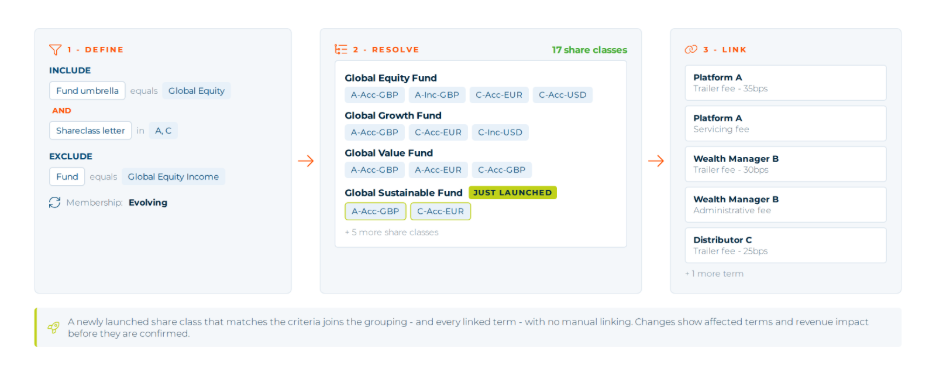
A product grouping replaces the need to link each term individually to its respective in-scope share classes. Instead of selecting share classes one at a time, you define the product group once - for example, every A and C share class in a given fund umbrella, excluding a named fund - and link the term to the product group.
A product group is defined once and linked to every financial term it applies to, and reused across every relevant agreement it is referenced in. Linking a term to a grouping links it to every member share class and brings them into revenue calculation.
A few principles make this work in practice:
- Inclusions and exclusions sit together. A broad inclusion can be narrowed precisely, so "the whole umbrella except Fund X" is expressed as it is written, not restated as a long list.
- Criteria reflect how ranges are really defined. Share class, fund and fee attributes are all available, so groupings can follow the same logic your commercial teams use.
- Evolving or fixed membership. Some arrangements are meant to follow the product range as it grows. Others cover a defined list. A grouping can be set to absorb newly launched share classes that match its criteria, or to hold its membership fixed from a point in time.
- Groupings and individual share classes coexist. A term can cover a standard range plus a small number of named exceptions, each with its own rate where required.
Three moments where it pays off
- Onboarding a new agreement. The work of identifying and linking share classes is done once, when the grouping is defined, and inherited by every term that uses it. Setting up a three-term agreement becomes three links at the product group level rather than 45 individual share class links. New agreements are onboarded faster and start producing accurate revenue figures sooner.
- Launching a new fund or share class. With an evolving grouping, a new share class that matches the criteria is added to every linked term as soon as it matches. The gap between launch and revenue recognition closes, and so does the risk of unbilled fees.
- Changing a range. When a grouping's criteria change, the consequences are shown before anything is committed - which share classes would enter or leave, how many terms are affected and the revenue recalculation that follows.
What good looks like
If you are assessing how your firm maintains distribution agreement terms, these questions are a useful test:
- Can a term's product scope be captured in a single grouping rule that matches the agreement?
- When a new fund or share class launches, is there a mechanism that brings it into the right terms, or does it rely on someone remembering?
- Can finance see which range a term was meant to cover, not just which share classes it currently lists?
- Is the impact of a change - terms affected, revenue recalculated - visible before it is made?
How Aiviq approaches it
In Aiviq, product groupings sit inside our Agreements & Terms module, alongside the financial terms they link back to. The use of product groups makes new agreements quicker to onboard, because a term covering a wide range is linked to one grouping rather than to every share class in it. Every grouping can also be searched, filtered and, exported with its status, share class count and linked terms, so you always know which ranges exist, how big they are and which terms depend on them, and can evidence it to audit or a counterparty in a single export.
The result is a terms model that will continue to capture commercial intent as the product group evolves, not just its current snapshot of product links - so the range you agreed is the range you account for.