For most of the last twenty years, the hard part of client data in asset management was keeping up: building a reliable picture of clients, flows and the intermediaries behind them. That data was built for reporting. Someone read the dashboard, noticed what looked off, and made the call.
AI changes what that data is for. Models can now suggest the next action, and more and more often they take it. A person can work around an odd number in a report, but a model acting on it repeats the mistake at scale. The space between what AI could do with a firm’s data and what the firm can trust it to do is what we call the decision gap. It is the subject of our new whitepaper, The Intelligence Gap 2026.
The first moves are already visible
Some of the largest firms in the industry are not waiting. Goldman Sachs is co-developing autonomous AI agents for trade accounting and client onboarding. T. Rowe Price has set up a dedicated Global Distribution AI team, so AI sits with the business that uses it. J.P. Morgan says AI has already saved it close to $1.5 billion.
What our research found
At Aiviq, we spent months testing how far AI can be trusted to act on client data on its own. Once the model understood the domain, the answer was much further than generic automation. In our client-matching research, a domain-trained model acted on 78% of decisions without a person stepping in, and it got there by learning from every correction our reviewers made.
In our work with asset managers, the firms getting real value follow the same pattern. They decide which decisions AI has earned the right to make, start with routine work, and keep people on the exceptions.
Inside the whitepaper
- Why a new decision gap has opened on top of the client-data gap
- What makes client data decision-grade
- How AI earns the right to act, from insight to autonomy
- How to build the decision flywheel inside the firm
- Why proprietary data is the moat a frontier model cannot buy
- Four predictions for 2027-2028, and the signs already showing in the market
Our four predictions
- Autonomy starts in the back office (by end-2027)
- AI moves to where decisions are made (by 2027)
- The cost gap becomes structural (by 2028)
- Clients move before regulators (by end-2027)
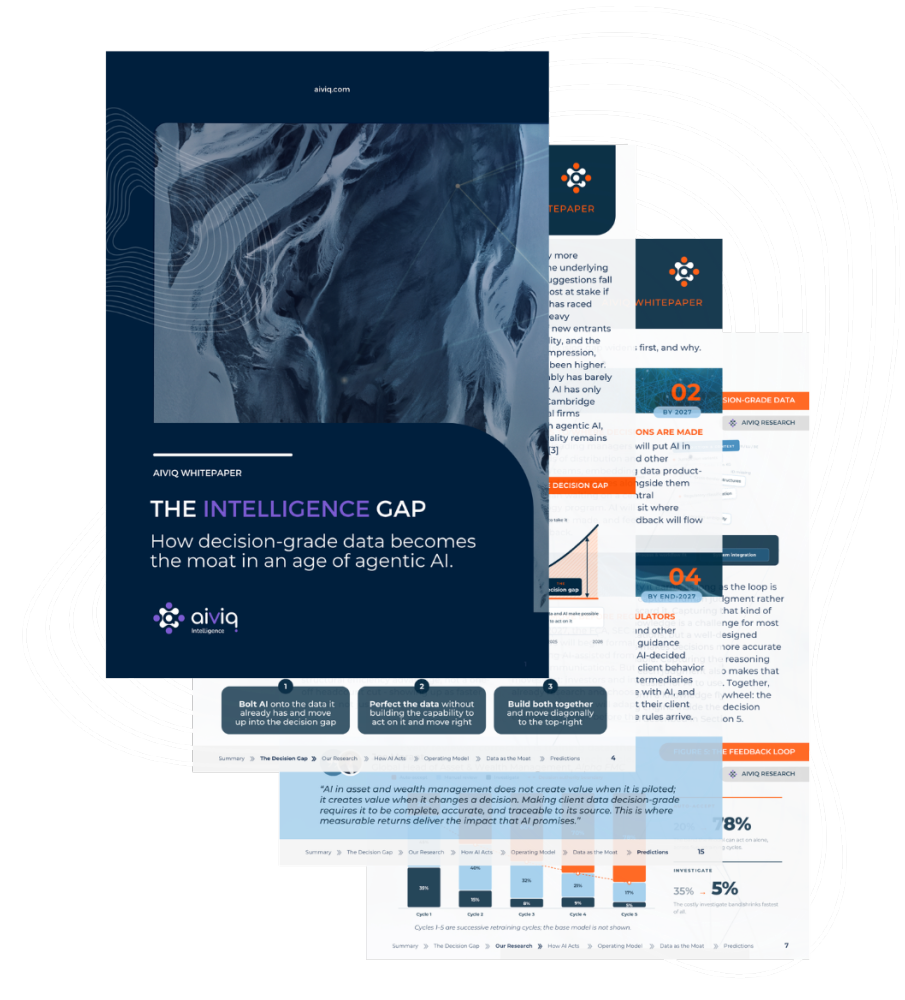
We wrote it for anyone in distribution, sales operations or client data who is deciding where AI should go next.
In this whitepaper, Aiviq draws on its own client-matching research to examine why AI in asset management is moving faster than the client data beneath it, and what firms need to put in place before AI can act on their behalf.