%20-%20Edited.jpg)
In Part 1 of this series, we explored why private market firms are losing the data battle - not because they lack data, but because that data is fragmented across fund administrators, deal systems, CRMs, and spreadsheets. We identified nine structural challenges, laid out three pillars firms need to address - a unified data model, a robust operating model with governance, and scalable technology infrastructure - and concluded that data clarity is the foundation of transformation, but the real advantage comes when clarity evolves into connected intelligence.
This raises an immediate, practical question: how should firms actually get there? Many instinctively reach for an in-house build - full control, full customisation. But in private markets, where data complexity is structural and ever-expanding, this path carries hidden costs that most firms underestimate.
The Private Markets Data Problem Is Uniquely Hard
Public markets benefit from a common data language - tickers, ISINs, daily NAVs, regulated exchanges. Private markets have no such equivalent. Every GP-LP relationship generates bespoke data: capital call notices with different formats, distribution waterfalls with custom terms, side letter provisions that alter fee structures, and valuation reports that arrive quarterly - sometimes months after period-end.
Layer in the structural complexity we outlined in Part 1 - multi-asset platforms, evergreen vehicles, continuation funds, co-investments, and secondaries - and the data landscape becomes extraordinarily fragmented. Fund administrators report differently. Registrars and investor services teams across jurisdictions use different identifiers. Wealth platforms onboarding into semi-liquid vehicles introduce entirely new data flows that traditional infrastructure wasn't designed to handle.
This isn't a problem that a few data engineers and an internal project can solve sustainably.
Why Building In-House Falls Short
Firms that choose to build internally often begin with a specific pain point: "We need a single view of our investor base" or "We can't reconcile our NAV across administrators." The initial scope feels manageable. But private markets data has a compounding complexity that in-house builds rarely anticipate.
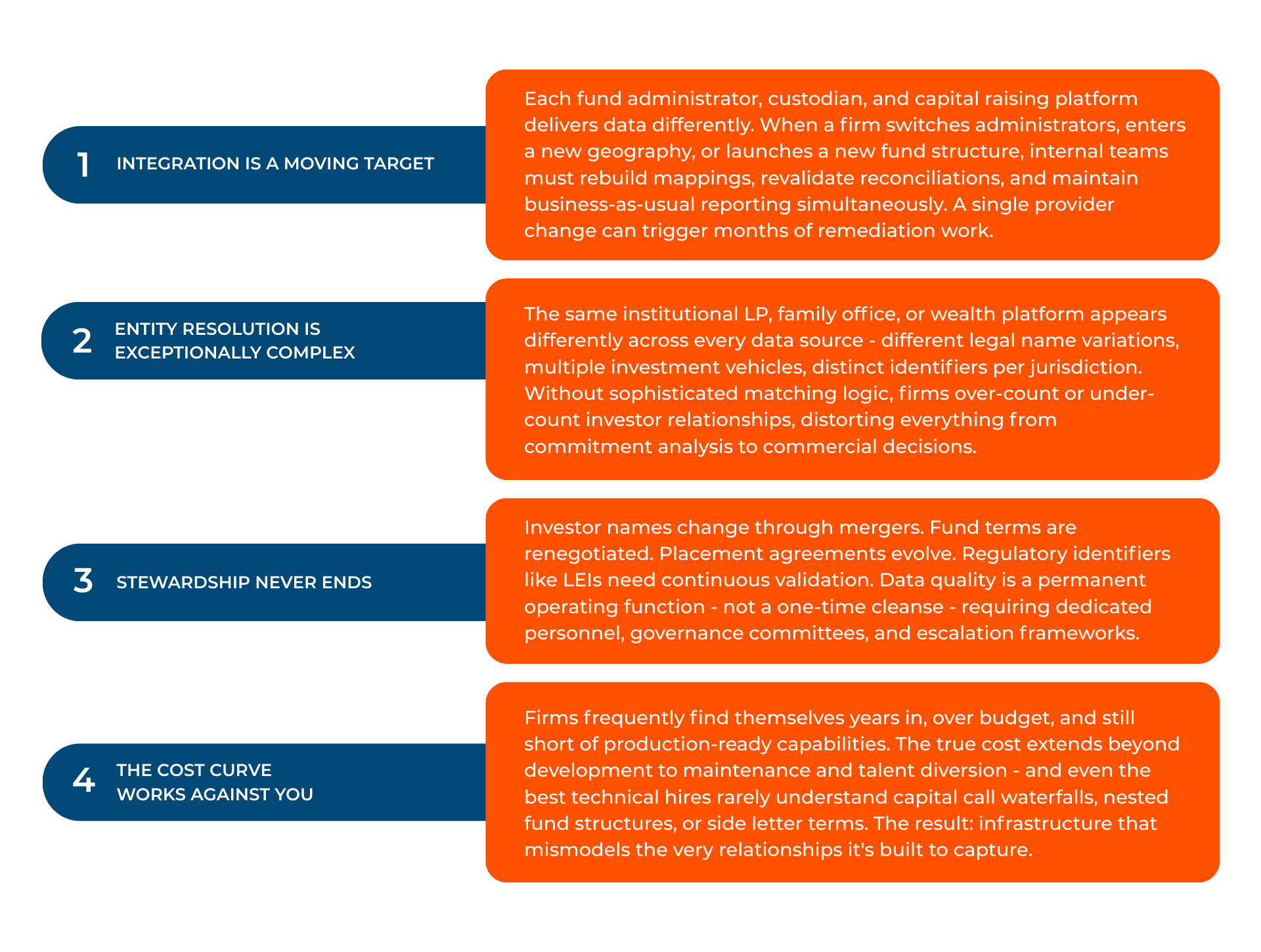
Integration is a moving target. Each fund administrator, custodian, and capital raising platform delivers data differently. When a firm switches administrators, enters a new geography, or launches a new fund structure, internal teams must rebuild mappings, revalidate reconciliations, and maintain business-as-usual reporting simultaneously. A single provider change can trigger months of remediation work.
Entity resolution is exceptionally complex. The same institutional LP, family office, or wealth platform appears differently across every data source - different legal name variations, multiple investment vehicles, distinct identifiers per jurisdiction. Without sophisticated matching logic, firms over-count or under-count investor relationships, distorting everything from commitment analysis to commercial decisions.
Stewardship never ends. Investor names change through mergers. Fund terms are renegotiated. Placement agreements evolve. Regulatory identifiers like LEIs need continuous validation. Data quality is a permanent operating function - not a one-time cleanse - requiring dedicated personnel, governance committees, and escalation frameworks.
The cost curve works against you. Firms frequently find themselves years in, significantly over budget, and still short of production-ready capabilities. The true cost extends beyond development to continuous maintenance and the opportunity cost of diverting technical talent from revenue-generating work. And even the best technical hires rarely bring deep private markets domain knowledge - understanding how capital call waterfalls flow, how fund structures nest across feeders and parallel vehicles, or how side letter terms alter fee calculations. The result is technically sound infrastructure that mismodels the very relationships it's supposed to capture, with no easy way to bridge the gap at scale.
What the Right Technology Partner Delivers
The case for partnership isn't about avoiding effort - it's about applying effort where it creates the most value. A purpose-built platform transforms years of internal infrastructure work into operational capability from day one.
Connectivity at Scale
Integrating with hundreds of data sources - each with different formats, delivery schedules, and identification schemes - is one of the largest barriers to a unified investor view. Every new market, administrator, or vehicle launch adds another integration project. Aiviq removes this friction with pre-built connectors to 300+ global data sources, including key private market platforms such as eFront, IQ-EQ, and Alter Domus, plus an ETL Design Studio that onboards new feeds without custom code - in weeks rather than quarters.
Universal Investor Recognition
The same LP, family office, or wealth platform appears with different legal names, identifiers, and addresses across every data source. Without purpose-built matching logic, firms can't answer fundamental questions like "What is our total relationship with this investor?" Aiviq's AI-powered recognition creates a universal investor record across all relationships, commitments, capital activity, and holdings - learning continuously from challenges across its client base, an advantage impossible to replicate with a single firm's data alone.
Embedded Governance and Stewardship
As we established in Part 1, technology alone doesn't solve data problems - stewardship does. But building governance frameworks from scratch means years of trial and error. Aiviq embeds proven stewardship directly into the platform: automated rules flag inconsistencies before they cascade into reports, workflow tools route exceptions to the right teams, and reconciliation processes ensure committed capital and NAV data balances across all sources - with every improvement shared across the Aiviq Client Community.
Fundraising and Capital Raising Intelligence
Most firms can't accurately answer who influences their capital commitments. Commitments arrive through a web of placement agents, wealth platforms, consultants, and direct relationships, and the data linking them is rarely captured systematically. Aiviq's attribution framework connects every party influencing commitments to actual money movement - enabling firms to measure fundraising effectiveness, identify high-performing relationships, and allocate resources where they generate the highest return.
Time-to-Value and Future-Proofing
Private market firms facing pressure to grow committed capital and demonstrate value to LPs can't afford multi-year build timelines. Aiviq accelerates deployment with ready-made data models, pre-built connectors, and proven workflows. While firms pursuing internal builds are still establishing basic infrastructure, Aiviq clients are already leveraging the Client Intelligence capabilities we introduced at the end of Part 1 - analysing investor behaviour, identifying growth opportunities across their LP base, anticipating redemption risk, and receiving dynamic executive briefings that drive data-informed fundraising strategy.
And as private markets continue to evolve - new wealth platforms, new capital raising channels, new regulatory demands like SFDR, AIFMD II, and evolving SEC requirements - Aiviq evolves centrally. When new platforms emerge, Aiviq builds connectors once and all clients benefit. When regulations change, the platform adapts. When firms need new attribution models or reporting formats, Aiviq develops them collaboratively with early adopters, then scales them across the client base. As part of the Aiviq Client Community, firms gain continuous access to tomorrow's capabilities without bearing the full cost of innovation alone.
The Strategic Imperative
Private market firms create value through investment performance, LP relationships, and fundraising excellence - not through data infrastructure. Fundraising teams should be deepening LP relationships and originating new commitments, not reconciling data files. Operations leaders should be optimising fund processes, not debugging matching algorithms.
For the vast majority of firms - whether emerging managers, established multi-billion-pound institutions, or global alternative asset managers - partnership with the right platform offers a faster, lower-risk, and ultimately more powerful path forward than building internally. Aiviq delivers a complete client data operating model, purpose-built for private markets, battle-tested across diverse fund structures and regulatory regimes, and designed to scale with the growing complexity of alternative investments.
In a market where fundraising excellence and investor intelligence increasingly define competitive advantage, choosing the right partner isn't a back-office decision - it's a strategic imperative.