
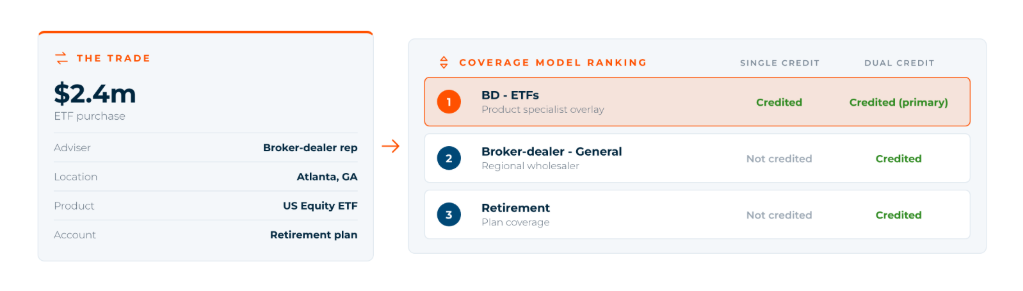
A financial adviser at a broker-dealer in Atlanta buys $2.4m of an ETF. It is one trade, but in a typical US distribution business at least three teams have a reasonable claim to it.
The ETF specialist team covers the product. The regional broker-dealer wholesaler covers the adviser. The retirement team covers the plan the assets sit in. Each operates under its own coverage model, and each one is right by its own rules.
So who gets credit?
Overlapping coverage is normal
Asset managers do not organize sales in one dimension. They run coverage models by line of business - broker-dealer, retirement, institutional, wealth management, international - and layer specialist teams on top for products like ETFs or model portfolios. Each of these overlays needs its own view of who owns which clients, over the same book of business.
In our work with asset managers, overlap is usually deliberate. A retirement team and an ETF team can both cover the same client, each measured on its own mandate. The problems start when nobody has decided how that overlap should be credited.
The cost of resolving it in spreadsheets
When attribution conflicts are resolved manually, the symptoms are familiar:
- Unplanned double counting. The same flow lands in two teams’ numbers without anyone deciding it should, and firm-wide sales reporting stops adding up.
- Disputes and delays. Compensation cycles slow down while sales operations adjudicate who owns what.
- Opaque logic. Precedence lives in someone's head or a spreadsheet, so nobody can explain why a trade landed where it did.
- Eroding trust. Once sales teams stop believing the attribution, they stop using the reporting built on it.
Three decisions, in order
Clean attribution depends on answering three questions, in order.
- Should more than one team get the credit? Some firms want every flow credited to exactly one territory, so totals always equal the book of business. Others run parallel overlays, such as retirement and ETF teams covering the same client, and want each one measured in full. Single credit and dual credit are both valid, but the choice has to be made once, for the whole business.
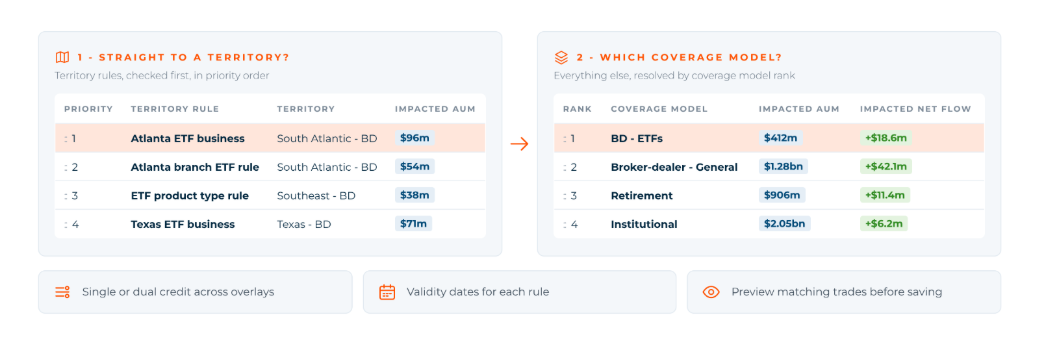
- Which coverage model comes first? Coverage models are ranked. With single credit, the highest-ranked model that matches takes the credit. With dual credit, every matching model is credited, and the rank decides which territory is reported as primary. The ranking is explicit and owned, and every change to it is recorded.
- Which territory receives it? The territory comes from the client’s assignment under that coverage model, and the contact takes precedence over the organization where both exist. Where business should go straight to a specific territory, such as an Atlanta ETF desk, a territory rule sends it there, and a rule priority decides which rule wins if more than one matches.
Separating the decisions keeps each one simple. Sales leadership agrees how overlays are credited and ranked, and sales operations maintain the assignments and rules within each model.
Territory rules people can read
A territory rule should read like the business logic it represents. For example: contacts in Atlanta, for products matching a given CUSIP, on provider data, through a named set of platforms.
That means a rule can use one criterion or combine several, across contact, organization, share class, fund, account, account entity, flow and flow materiality. All criteria in a group must be met, a single criterion can hold alternatives such as two named platforms, and carve-outs can exclude specific firms from an otherwise broad rule.
Rules also need a life cycle. Validity dates let a territory change take effect at the start of a new sales year without anyone having to remember to switch it on.
Make the impact visible before it changes
The most important feature of any attribution change is knowing what it will do before it happens. Two views make that possible:
- Impacted AUM and net flows shown against every coverage model and every territory rule, so the commercial weight of each is clear when reordering.
- A preview of matching trades before a rule is saved, so the team can see exactly which activity a rule will capture.
Changes to ranking or priority are confirmed before they are applied. The result is attribution logic that can be explained to any salesperson, on any trade, because every credit records the rule, override or default territory behind it.
A quick health check
If you are reviewing how your firm attributes sales credit, ask:
- When the same client is covered by several overlays, have you decided whether each one is credited in full or only one?
- Is there a single, documented order of precedence between coverage models?
- Can you explain, for any trade, why it was credited to a particular territory?
- Can you see the AUM and flows at stake before changing a rule?
- Do territory changes have effective dates, or are they switched on manually?
- Does attribution work at adviser level, not just firm level?
How Aiviq approaches it
In Aiviq, sales territory management runs on the same matched AUM and flows, client hierarchy and contact data as the rest of the Aiviq Client Master, so there is nothing to reconcile between attribution and reporting. Firms can run up to 30 coverage models over one book of business, choose single or dual credit, split a relationship between territories by percentage and correct individual transactions with overrides. A default territory catches anything no rule covers. The impact on AUM and flows is shown before a ranking or rule changes, and every credit can be traced back to the rule, override or default that produced it.